Category Archives: Radical Tradition

Rendering Beethoven

Composer Ludvig van Beethoven wrote thirty-two piano sonatas, nine symphonies, and many other works, most of these during the early part of the nineteenth century.  Of course, the first manuscripts for these works were written by Beethoven’s own hand – the originals. Once completed, these autograph musical scores would then be hand copied by professional copyists under contract. These copies would be reviewed and corrected by Beethoven himself.

Because this was the nineteenth century, the next phase of preserving sheet music was the music publisher for engraving and printing. This was a painful and error prone process that took a lot of hours by highly specialized workers. The handwritten copy would be used to etch a reverse image of the music on copper plates which would be inked and pressed onto paper. Hundreds of copies of a sonata or symphony could be created from a set of corrected copper plates. These first editions could be sold to professional musicians, orchestras, and music societies. They were not cheap.

Assuming each stage was error-free, and each copy was identical to the autograph original, it was not a sufficient means of conveying how to play Beethoven’s music. Beethoven had to work directly with musicians who performed his compositions. He corrected, marked scores, rehearsed, and gave very specific instructions concerning performance.

Some musicians who knew Beethoven personally became important transmitters of his performance practices, preserving aspects of the approach to his music that the written document alone could not provide. One especially prominent figure is Carl Czerny, a celebrated composer of his time. Czerny was Beethoven’s student and knew his teacher’s playing firsthand. Czerny later wrote extensively about how Beethoven’s works should be performed and imparted that knowledge to his own student, Franz Lizst, another famous musician and composer of the nineteenth century.  

Today, when I want to listen to a piano sonata or symphony of Beethoven’s, I might purchase a compact disk or stream the music from Spotify. I especially like Symphony No. 6 – The Pastoral Symphony. But not only can I listen to this whenever I want, I can also choose the orchestra/conductor that renders it: Wiener Philharmonic/Karl Boehm, Berliner Philharmonic/Herbert von Karajan, and many others.  

And these renderings vary. The tune is recognizably the same, but the performance might vary in tempo, emphasis, technique, rest, interpretation, style. Some musicians may study the musical tradition that surrounds the piece and attempt to re-create “authentic” Beethoven even using period instruments. Others may take the printed score and simply use their own judgement.

But if one wished to hear Beethoven’s Sonata Pathétique or Pastoral Symphony exactly the way Beethoven himself would have played it, could that be done today from sheet music? Given that Beethoven himself had to work with musicians directly to ensure the piece was played faithfully to the composer’s intent, the answer is no. And, if that were at all possible, every modern recording attempting authenticity would sound the same. But they do not, they sound different, substantially different.

As an illustration of this, I fell in love with Monteverdi’s 1610 Vespers, something I had recorded onto tape from FM radio when I was a college student. I knew it was the 1610 Vespers but never caught the name of the ensemble. Nevertheless, I purchased a CD of the work performed by John Eliot Gardner thinking it would be the same.

Alas, it was not the same, and it did not have the same effect on me.  Though I kept the CD, I never played it much and settled on the radio recordings until I figured out decades later that it was Andrew Parrot—long story.

But imagine if Beethoven established a school that trained musicians to play his Sonatas and Symphonies in the way he intended. And through this school he provided a method of training that could be passed down accurately from generation to generation so that while the school existed, the manner of playing his works would be maintained. The school would not replace the written music; it would teach the musicians how the composer intended that written music to be rendered. Although there might still be recordings of the sonatas from various artists with various interpretations, if one obtained a recording from a musician certified by this established school, presumably one would be able to hear a work exactly as Beethoven would have played it.

Theological Note

The story of Beethoven and his music is an analogy for Christ and his teachings, except Jesus did not jot down the beatitudes, parables, and his arguments with the Sadducees.

The teachings of Jesus indeed come to us in written form in what we call the New Testament, but those are works provided by his disciples.  In the same way Beethoven’s students studied under the composer, Jesus disciples “studied” under him. In the same way Beethoven’s students wrote extensively about their teacher’s methods, Jesus’ disciples wrote extensively about their master’s life and teachings.

In the same way that sheet music alone is inadequate to reproduce the intended music of Beethoven, the bible alone is insufficient to understand the teachings and life Jesus calls everyone to. In fact, the Gospel of John tells us there is not enough paper and ink to document all that Jesus said and did (John 21:25). You think that might be important?

Fortunately, Jesus established a “school” that from generation to generation preserves and transmits his teaching and his call to discipleship accurately including those things not written down. This school is called the Church founded by Jesus Christ and first built upon his apostles, notably Peter, and transmitted to us through apostolic succession. In the same way Beethoven taught Czerny and Czerny taught Liszt, Jesus taught John and John taught Polycarp not with books and writing but by a constant proximity to the source.  

The analogy of musical tradition to that of sacred tradition carries further. It’s not as crucial for Beethoven’s school of music to have the exact, inerrant sheet music of the composer since the tradition carries across copy errors, misattributions, and so forth. The written note is not the sole source of authority but a part of the school itself, the real authority on how to play Beethoven or, analogously, teach Christ to future generations.   

But those trying to duplicate Beethoven from sheet music alone may not, and probably won’t, get it right even if the score they have is completely void of error.  To improve their rendering, they will study the context of the writing, compare it to other works and so forth. They regard the sheet music as the source material, rather than any school, so it is essential it be accurate and free of mistakes. Even then, it’s bound to fall short of the mark.

Jesus did not write a Bible but transmitted his life and teachings through his disciples as a craftsman would transmit abilities to an apprentice. He established a Church that he promised would not be prevailed upon by the gates of hell. The Catholic Church has preserved this deposit of faith for two thousand years and continues to transmit it from generation to generation.
This Too Shall Pass

A Generation

With each bank of hours, staring into oblivion, bending every pathway in my mind, hoping to find an undiscovered calculus, I arrived at the same unwelcome result. And then the calculations would start again dammit, each iteration lowering me further into a yawning darkness.

My mother would thrust her finger through my chest clear to the other side: “This too shall pass. This too shall pass.” I wanted to believe her words, spoken as both a hope and a declaration–like Gandalf at the bridge of Khazad-dûm shouting to the Balrog demon that played hell with me.

Every April 10, I recognize the anniversary of this misery; indulge me. I reckon it this day based on a peculiar memory: what must’ve been the largest one-a-day calendar ever, bolted to a wall, the number ten writ large upon the paper; and it was April. Assuming the staff was diligent about stripping off a billowing sheet each morning, then that was the day a tumor was removed from my neck. One week later I was diagnosed with cancer. I was a clueless runt all of fourteen and this was not exactly the growth spurt I was promised.

Such a diagnosis one decade earlier would have been fatal; but in 1980, before the Internet and the Fall of mighty Carthage, I stood an even chance. Chemotherapy was still a dark art and there was much uncertainty about her incantations. It was determined, after 6 months of treatment, a computerized coin flip would decide if another 12 months of the regimen was required. Why 12 and not simply another 6 was curiously never questioned. At any rate, this was a nation-wide study to determine dosage since the drugs had devastating, often deadly, side effects: Methotrexate is used as an abortifacient. Cytoxan can permanently sterilize. All of them interfere with metabolism and DNA duplication; add daily doses of radiation minus the x-ray vision and superpowers. It goes without saying that my tenuous dreams of being a rock star were thoroughly dashed, especially in the era of big hair bands. As one of the doctors presaged, I’d contract leukemia in my thirties should I survive so long.

My thirties? What did I care? That was an impossible and distant future for someone measuring his life in moments, like Antonius Block in the Swedish film Seventh Seal:

I shall remember this hour of peace… I shall remember our words and shall bear this memory between my hands…

I would pray, sometimes on my face: How can I hold the moments of life between my hands like a bowl of strawberries? Why do the seasons pass? Where are the years the locusts have eaten?

Back then, my mother, a woman of immense faith, protected me with the power of prayer. Her janky Plymouth Horizon made at the lowest point of American automotive innovation served as our chapel on wheels. Whenever we parked that car—often at some Gigeresque underground parking lot of a medical facility—Mom would pray over everything: me, the doctors, the nurses, the interns, the radiologists, the treatments; anyone and anything remotely associated with the circumstance. She would invoke the name of Jesus, quote scripture, denounce the Devil, and made sure that every spiritual and corporeal entity knew who, what, when, where, how, and why. 

This activity was not confined to the lowly Detroit beater. As part of every round of chemotherapy, Mom would ask the luckless administering doctor if we could all pray first. No amount of medical school and gunshot wounds might have prepared him for such a thing. In any event the doctor would respectfully pause before injecting me with chilled chemicals that immediately filled my mouth and nostrils with the taste of moth crystals. Twelve hours later I’d be puking up my large intestine along with the foul hospital ravioli I had for lunch.

Hear, O my son, and receive my sayings; and the years of thy life shall be many. (Prov 4:10) [1]

My father, a man of blood and iron, probably preserved my life with a daring decision. Raised poor and fatherless in the Great Depression, Dad was the type of man who did what needed to be done despite sentiment or professional opinion. Be it bludgeoning an animal out of its misery or unceremoniously telling his teen-age son he’d lose all his hair, Dad did so without the luxury of introspection. Once when my brother managed to hammer a nail perfectly into his index finger, it was Dad who yanked it out with knuckle-white hands rather than rush to the hospital for careful diagnostic imaging. Only God knows how Joel managed an impossible self-impaling or how Dad deftly removed it without inflicting yubitsume.  

After the required 6 months of therapy, it was determined by chthonian lottery that I should remain another 12 months more on chemotherapy: tails, bwa-ha-ha, you lose! When Mom and I were told this outcome on what was supposed to be my final day of treatment, I disintegrated.  If that wasn’t bad enough, the new doctor on staff mistakenly informed us that 18 more months would be required (more supervillain laughter), dropping my heart into the sink of despair.  

Years later, after my father passed away, I learned it was he who made the decision to discontinue treatment. Mom couldn’t deal with the dilemma. From her account, Dad merely called the oncologists as perfunctory as ordering a pepperoni pizza (always double cheese), informed them of his decision, hung up, and went back to work: heads, ha, I effing win!

Maybe. It was not until I was a parent that I understood the courage of that decision. Going against the recommendation of doctors, Dad took a tremendous risk. Had the cancer returned, it would have done so with more aggression and—well–good night dour prince. I have a difficult time imagining the weight of guilt that hung in the balance. Fast forward to this day and no one can dispute Dad’s decision.

My son, hear the instruction of thy father, and forsake not the law of thy mother: For they shall be an ornament of grace unto thy head, and chains about thy neck. (Prov 6:20)

And now, here I am, fifty plus, married, and the improbable father of two daughters. By this account, I am the richest man I know, for who may buy a single day, let alone forty years, with their wealth? As Mom hoped and declared, that too did pass and today, because of my mother and father, I have the luxury of introspection…

In antiquity, forty years was the measure of a generation and signified a period of testing. Jesus predicted the destruction of Jerusalem in “this generation” and exactly forty years later the Romans besieged the Holy City. Moses spent forty years in Egypt, forty years in exile, and another forty years in exodus. The children of Israel wondered the desert and ate manna for forty years. The first kings of Israel–Saul, David, Solomon–each reigned forty years. On its own, forty years portends a certain significance and meaning. Even the very date, 04-10-2020, reveal operands to calculations of forty, being also the 100th day of the common year.

But is it not more auspicious that this remarkable Ruby Jubilee falls on Great and Holy Friday? That exactly one generation later this experience would point to Christ’s crucifixion and the ultimate conquest of death and fear:

Behold! I tell you a mystery. We shall not all sleep, but we shall all be changed, in a moment, in the twinkling of an eye, at the last trumpet. For the trumpet will sound, and the dead will be raised imperishable, and we shall be changed… then shall come to pass the saying that is written: “Death is swallowed up in victory. O death, where is your victory? O death, where is your sting?” (1 Cor 15:51)

The lessons of that time can be brought to bear on our present pandemic and quarantine: part curse, part blessing. It is in these moments of testing we are asked to grow up and think about life with the utmost clarity; to take inventory of the moment and give thanks for what we have; discard the foolish, shallow, and banal; make restitution and reconciliation while the time is ever short; to ask if life is not more important than the multitude of things we worry about. To take courage in knowing that the Lover of Mankind is on our side and not opposed to us—so do not fear.[2]

This too shall pass. This too shall pass.

When you descended to death, O Immortal Life, You destroyed Hades by the splendor of your Divinity, and when you raised the dead from under the ground, all the Powers of heaven cried out: O Christ our God, the giver of life, glory to you. [3]

O Great and Holy Friday!


[1] Curiously, Prov 20:20 is “Whoso curseth his father or his mother, his lamp shall be put out in obscure darkness”.

[2] Ps 118:6

[3] Resurrection Troparion

Mass Tourism VII – St. Sebastian, Garmisch-Partenkirchen

See introduction to Mass Tourism series here for the motivation behind these essays.

_dsc7169

_dsc7177

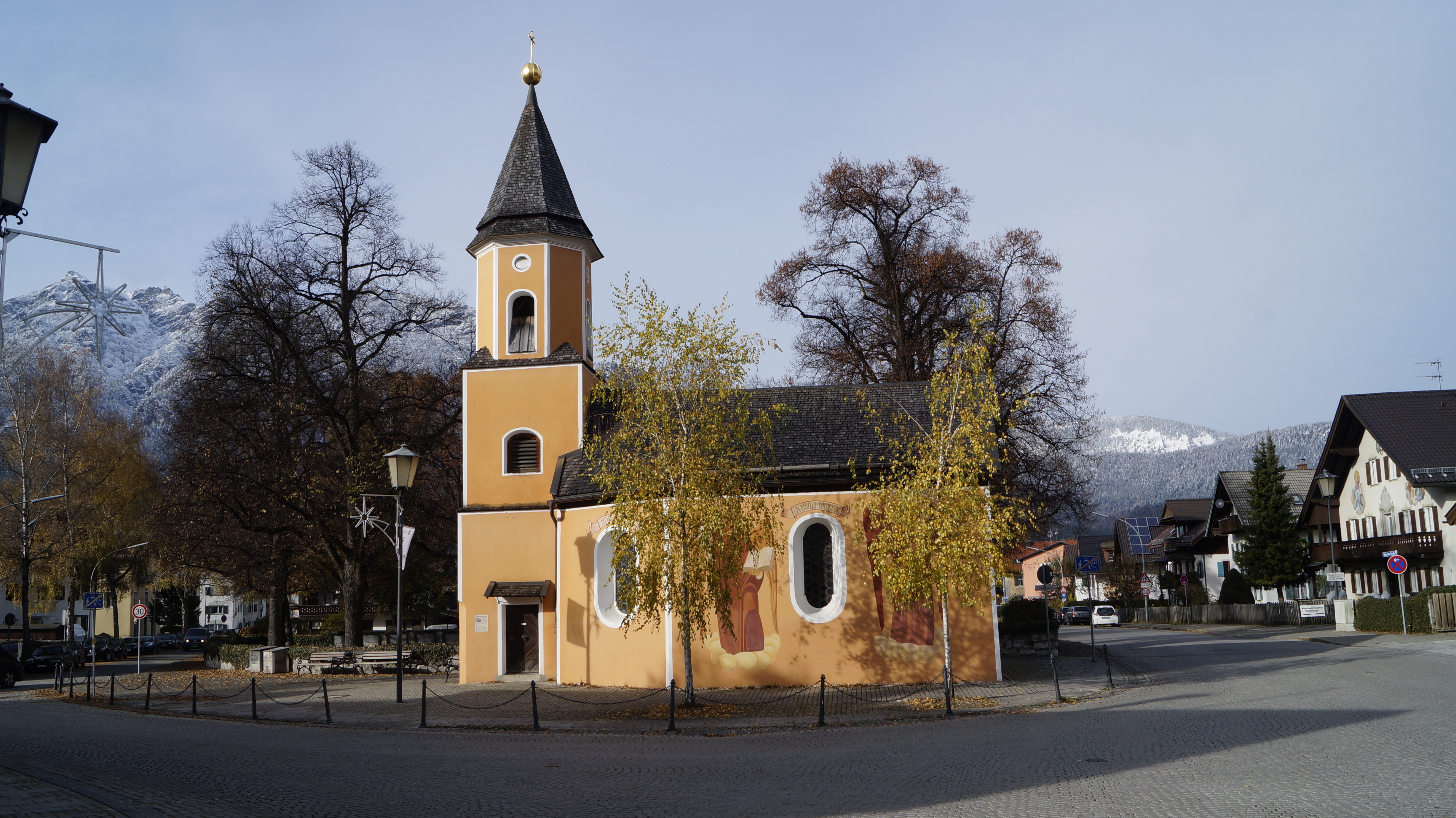
Sunday morning (Nov 13), I left to attend St. Sebastian which posted a Latin Mass time of 10 AM. This tiny chapel in the middle of town at a sharp turn on the historic Ludwigstraße was built in 17th century and is the oldest church in Garmisch, if not the oldest building there altogether. All psyched up to attend Mass in a foreign country with no ability to “low-profile”, I arrived at the door which was locked shut. Peering through the dark windows, it seemed no one was there. A note tacked to the door revealed the situation, albeit in German. I was sure it stated that the Mass was postponed to 6PM. Nevertheless, I waited until the prescribed hour before returning to the apartment.

I decided to stop by the Netto market for bread but, wouldn’t you know, it was closed Sunday as were most businesses. Once upon a time it was true in America (and still in some towns)—that Sunday was a holy day of rest and one managed to reckon that fact into the week.

[Aside: Imbued by the culture, I have come to expect that stores will be open 24/7 for my convenience. I am convicted of the idea that we should return to a Closed-Sunday culture if not for religious purposes, but simply for the health and sanity of American society warped on money-making. Once attending a travel soccer game far away in Charlottesville, another father who I usually sat with was mocking the idea that local stores would be closed on Sunday for religious purposes (e.g. Chic-Fil-A). I just smirked in response but what I really wanted to say was, “You jerk! Do you think other families would like to spend time together at least one day of the week like you do? Is it so important that you get your hamburger value meal and a venti coffee at any hour of your life that others must scratch out a meager living to accommodate your every wish?” But I relented since I don’t exactly boycott businesses on Sunday myself.]

I returned to the chapel at the re-appointed time when all was dark and the streets were mostly empty. This time the chapel was open and some people had shown up. As I entered through the old wooden door, I immediately remember what Sigrid had told me, that there would be a group of people saying the rosary. I listened intently to determine what prayer was being uttered in German. The Fatima prayer almost sounded like the English version.

The chapel is very small, about 8 rows of pew split with a center aisle, each side wide enough to seat 3-4 people. There was absolutely nothing ergonomic about the sitting, the old pews possibly designed for function alone and no comfort—perhaps even mortification. I was forced to sit completely erect as the back rest shot a straight vertical with a seat slightly better than a 2×4 plank. Kneeling was no better, the kneeler raised so high, my feet could not touch the ground and my upper body ready to topple over the pew in front of me.

At the head of the church, the tabernacle was positioned tightly to the left side of the altar as if space would only allow that location. Above the altar was an old darkened painting of St. Sebastian, characteristically riddled with arrows and a doleful look heavenward.

Two priests entered through a side door, the celebrant being a man very young—around thirty—not something I imagine when I think of a Catholic priest. It was not just in my head that he fixed a prolonged stare on me–the oddity in this small chapel of senior women. Who let the American riff-raff in?

Ah but I had prepared my missal for this moment, reckoning that it was the 26th Sunday of Pentecost and my kindle at the ready with highlights. Mass started with Asperges, the traditional rite of sprinkling holy water on the congregation while the same traditional introit hymn is sung. The pews had been provisioned with a gray book Gotteslob which I saw in every church in Germany—an all-purpose book for the new liturgy and hymns. This chapel, however, had an additional small green booklet that was the hymns and responses for the High Latin Mass. For the most part, the Mass followed the words in my electronic Missal for the appointed day. Those parts where I was versed in the response, e.g. “Domine, non sum dignus ut intres sub tectum meum…” I made sure I was clearly heard so that everyone could be at ease that I just did not stumble into their singular worship service after touring Ludwigstraße purchasing bratwurst and souvenirs. American Riff-raff my foot!

Communion was kneeling at a 4-person altar rail which took all of 2 minutes. In this form of the Mass the communicant does not say Amen or anything—just quietly take the consecrated bread by mouth. I received the Eucharist in my mouth which I wasn’t nervous about. I think kneeling to take communion at an altar rail provides a certain level of security.

I meandered out of the Chapel after the final hymn. Waiting outside was the man sitting behind me. He was a distance from the door as if waiting for his spouse to pop out so that they could go home–typical. He looked at my brightly, “Guten Nacht.” I smiled and responded the same in my feeble German as I turned to go back to the apartment in the opposite direction.

Garmische-Partenkirchen

Kimberly and I are in Europe, combining our 25th anniversary, pilgrimage, and an opportunity to stay at a friend’s apartment in Garmisch-Partenkirchen. And now I can see why my friend abides here several times throughout the year. It is astoundingly beautiful with Zugspitze and other towering alpine peaks guarding the town on all sides, its historic cobblestone Ludwigstraße with restaurants and shops, and the handsomely built Bavarian homes with dark wood accents, gable carvings, tiled roofs and white stucco walls. Indeed, Garmisch-Partenkirchen looks like the place Busch Gardens tried to pretentiously replicate in their theme parks.

But Garmisch-Partenkirchen has a deeper beauty Busch Gardens could nor would ever attempt to replicate, a beauty forged from centuries of tradition and spirituality that calls from an integrated Papal Christian Europe.  On walls and in windows, be it a home, hotel or bakery, are crosses (cum corpore), statues, and images depicting Jesus, the Virgin Mary, Apostles, saints, or scenes from the Bible. In backyards, amid fields, and along roads are numerous small gabled shrines of the crucified Christ. These are created in the artistic tradition of the West to forever proclaim the gospel to an illiterate world, not because Gutenberg had yet to mass produce books centuries ago, but because Zuckerberg has mass produced social media on Facebook in our own day, heralding another dark age in which knowledge is not burned by the barbarian hordes, but buried in the big-data deluge of the mundane and meaningless.

Even in the local language, there is an unabashed and unbuffered perspective on life and the eternal. Around here one may say “Guten Tag” or “Auf Wiedersehen” but it is often to hear “Grüße Gott” which I believe literally means “God’s Greetings”. Imagining such fixtures in the United States, the images would be defaced, the monuments would be removed by judiciary, the businesses would be boycotted, the greeting would be met with scorn or rebuke. Consequently, we have no culture, no identity, no conviction and no truth. We have only power and the world view of those that wield it. As Hillaire Belloc stated in his book Characters of the Reformation: “The religion of the government becomes the religion of the state.” Is he wrong?

The Reformation (or at least the ultimate manifestation of it) roughly divided Germany into the Catholic south and Protestant North. This was more political than religious and resulted in state religions (the Church of ENGLAND, the Church of NORWAY, the Church of DENMARK to illustrate the point). In Germany (then the Holy Roman Empire) it was the religion adopted by the prince in whatever principality or territory ruled over. For the ordinary subject that meant adopting the prince’s world view or have a rough life of persecution to look forward to.

CUT TO: The United States of America where, supposedly, there is no official State Religion by Constitution. It sounds great on paper but in practice it has evolved to be the same thing as Old Europe.  If I don’t embrace the administration’s stance on faith and morals (homosexuality, same-sex marriage, abortion) I can expect legal or financial persecution: no federal funding for schools that are not on board with trans-gender bathrooms; no tax exemption for churches that preach against the power of the state; severe penalties if I object to selling abortifacient drugs; total annihilation if I don’t use my business in support of a same-sex wedding ceremony.

So I ask again, is Belloc wrong?

Mass Tourism VI – Time Traveler Edition

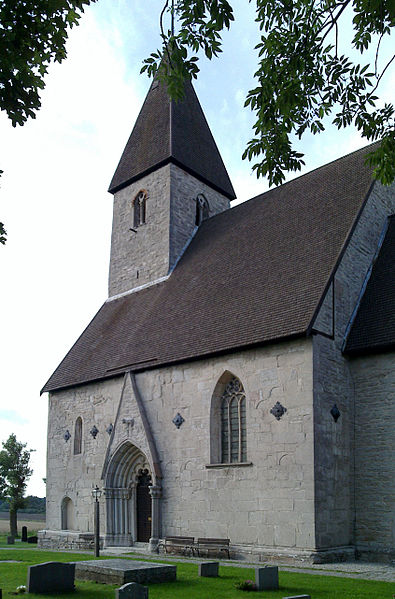
395px-endre-kyrka-gotland-torn3

See introduction to Mass Tourism series here for the motivation behind these essays.

This week I did not visit a local parish or go to Mass while on vacation. I did not participate in some Eastern rite of the Catholic Church as I am wont to do. No, this time I went to the small Endre parish— located one mile east of Visby on the island of Gotland, Sweden built in the 12th century—where Fr. Anders Piltz celebrated the Holy Sacrifice of the Mass on October 5, 1450, the 18th Sunday after Pentecost, many years before the Protestant Reformation.

Fortunately, I was somewhat prepared, having studied the traditional rite as it was celebrated for 400 years from the Council of Trent to Vatican II. But this was even before the establishment of the Tridentine Mass and there are several differences.

Endre has distinctly older components, specifically a rood screen that separates the people from the priests and all liturgical activity. It is only until communion that the faithful cross into the sanctuary to receive the consecrated bread kneeling down. A small version of what looked like an iconostasis stood above the altar.  Thin narrow stained glass windows punctuated the front and sides of the sanctuary. A roughly crafted crucifix hung under the pointed Gothic arch in front of the public area. The nave was walled solid with fading frescoes. A dull, cacophonous bell was sounded at the usual parts of the ritual.

The rite was, of course, in Latin and many of the liturgical formulas (Gloria, Credo, Sorsum corda, Sanctus, Agnus Dei) are exactly the same as we use in the current Novus Ordo Latin rite although the responses were not provided by the people but by a professional cantor. Some responses were not evident, such as the Confiteor or Suscipiat. The vesting prayers I could not equate to those I studied in Latin class but I understand these can vary. The Mass readings and specific prayers for that Sunday in the liturgical calendar adhered to the 1962 Roman Missal I possessed. The priest stood ad orientem as was the norm prior to Vatican II and is presently being revived. The incensing of the altar and then toward the people prior to the Liturgy of the Eucharist is exactly as is done at St. Catherine’s most Sundays. Much of the intonation was barely audible as parts were conducted discretely. This was the practice for centuries—the sacredness and mystery of transubstantiation was too prone to misunderstanding and vulgarization, and catechumens were dismissed before the Eucharistic Liturgy as a precaution.

Even though the liturgy of the Mass has changed, it’s astounding just how much of it is still intact and recognizable over five and half centuries later including an overhaul of the rite in the early 1960’s. Should you also wish to travel back in time and witness what Mass was like to ordinary people, simply click here.

And bring an old missal.

Mass Tourism IV

See introduction to Mass Tourism here.

Not on vacation or a week away, I decided to “tour” a few local parishes. In the first case, the time slot of my usual novus ordo Solemn Latin Mass was being used for first Holy Communion in English. Since it was mostly going to be a family affair, I decided to go to St. John the Beloved in McLean to participate in the Traditional Latin Mass—the “extraordinary form” that had been celebrated for four centuries between the Council of Trent and Vatican II, after which it was relegated to seldom use in a season of “renewal”. Ironically, these liturgical changes were enacted November 29 1964—the start of the liturgical year that I was born. After studying the TLM in my Latin class, I am prone to believe that “promoting” the TLM was a big mistake. Fortunately, there are a number of priest and parishes in Northern Virginia that are authorized to celebrate it and I am increasingly prone to take advantage of it.

You can imagine the paucity of people attending the service marked by many women wearing mantillas.  In the two times I went to TLM before I was totally lost but this time I had with me my Kindle which this time had a copy of the pre Vatican II 1962 edition of the Roman Missal. Smug mode. I found the Pentecost Sunday pertaining and I was able to follow along—and now the secret is out. Also, the novus ordo had prepared me for many of the responses and I actually felt like I had participated when it was all done. Smug mode plus.

On the second occasion of tourism, I visited Holy Trinity in Gainesville after work late on Friday in which Mass is occasionally celebrated.  This is a new church with a very unusual architecture—not modern by any means but not the ornate gothic structures of central Europe. I recall reading somewhere that it was based on early English (I suppose before Henry VIII) influence. I recommend a look inside.

The Mass was like most abbreviated weekday versions. The opening verses and responses I could not identify (maybe Angelus). Some of the responses were sung in Latin, e.g. Sanctus, Agnus Dei, which I happen to know. Smug mode thrice. Two things stood out on this occasion: the communion host was provided intinctured which means the priest dips it in the wine before giving it to the communicant. This means I wasn’t going to take it by the hand as I am most comfortable doing.  Fortunately, I did not mess it up and all went well.

The other event involved a 3-year old boy writhing about so much that his mom carried him to a nearby fenestrated room likely designed for such occasions. At some point I heard/felt this massive thud wave-propagate through the stone floor. Was that? Yes, the lad had writhed about so much he landed on his large float-away head which, apparently, went over like a lead balloon. The wailing and screaming soon followed making a few people cringe—that must’ve hurt bad, really, really bad. My head hurt just thinking about it.

At any rate, I am likely to visit these two parishes again in the future. Both celebrate the TLM at some point in their week and I may want to check out Holy Trinity if occasion permits.

Ite Missa est.

Dr. Scott Hahn

Converts to Catholicism from various denominations of Christianity may attribute, at least in part, their conversion to the writings and teaching of Dr. Scott Hahn.  Many years ago when I was living in Burtonsville, my friend Mike, a devout Catholic, gave me a book written by Dr. Hahn, an ex-Protestant theologian whose learning led him to the Catholic Church where he now resides as a scholar and apologist.  With marginal interest I skimmed the book entitled Rome, Sweet Home, not entirely interested in what I thought were the complicated mechanisms of the Catholic traditions of Christianity, figuring that I’d “been there, done that”[1].  I handed the book to my ex-Catholic mom who was the best pitch for why I wasn’t a Catholic anymore. Understand that I wasn’t invalidating Catholicism, nor was I ever anti-Catholic, I just thought that it wasn’t the denomination[2] for me. To be honest, I had harbored some doubts about doctrinal items but then, in my mind, all denominations had their strange markings: no dancing, no drinking, no musical instruments, snake handling, women cover their heads, speaking in tongues, slain in the spirit, prophecy and other whistle-evoking distinctions. And that always struck me odd; it seemed every denomination had some preoccupation with an aspect of Christian teaching blown to the extreme and made into a denomination in its ultimate manifestation. This provided a certain liberty to do what I wanted because, after all, no one could agree on the color of an orange. I also chalked it up to God liking variety—seemed reasonable but then maybe not entirely true.

Fast forward to recent years when another friend started handing me Lighthouse Media CDs which I would listen to—still defensively–on my commute. Some of these were testimonies from converts but many were teachings from Catholic apologists like Patrick Madrid, Fr. Barron and Dr. Scott Hahn. Hahn was particularly interesting since, due to his Protestant background, he emphasized the teaching of scripture and the fullness of Catholic conformity. One of the first teachings I heard from him was that on the Eucharist under the scrutiny of John 6 and this blew me away. He’s also did one on the office of the pope and that surprised me too. Finally, his book called The Lamb’s Supper talked about Revelation in ways non-Catholic Christians never hear—it was striking.

During my RCIA last year as I was quietly moving toward conversion I visited my Mom in her new duplex where she still had been unpacking. I had not planned to share with her the spiritual changes in my life when, suddenly, she handed me a book that she thought belonged to me—Rome, Sweet Home. To think it resurfaced then after 15 years. Of course this unleashed a torrent of dialog and when I brought the book home I read it all.

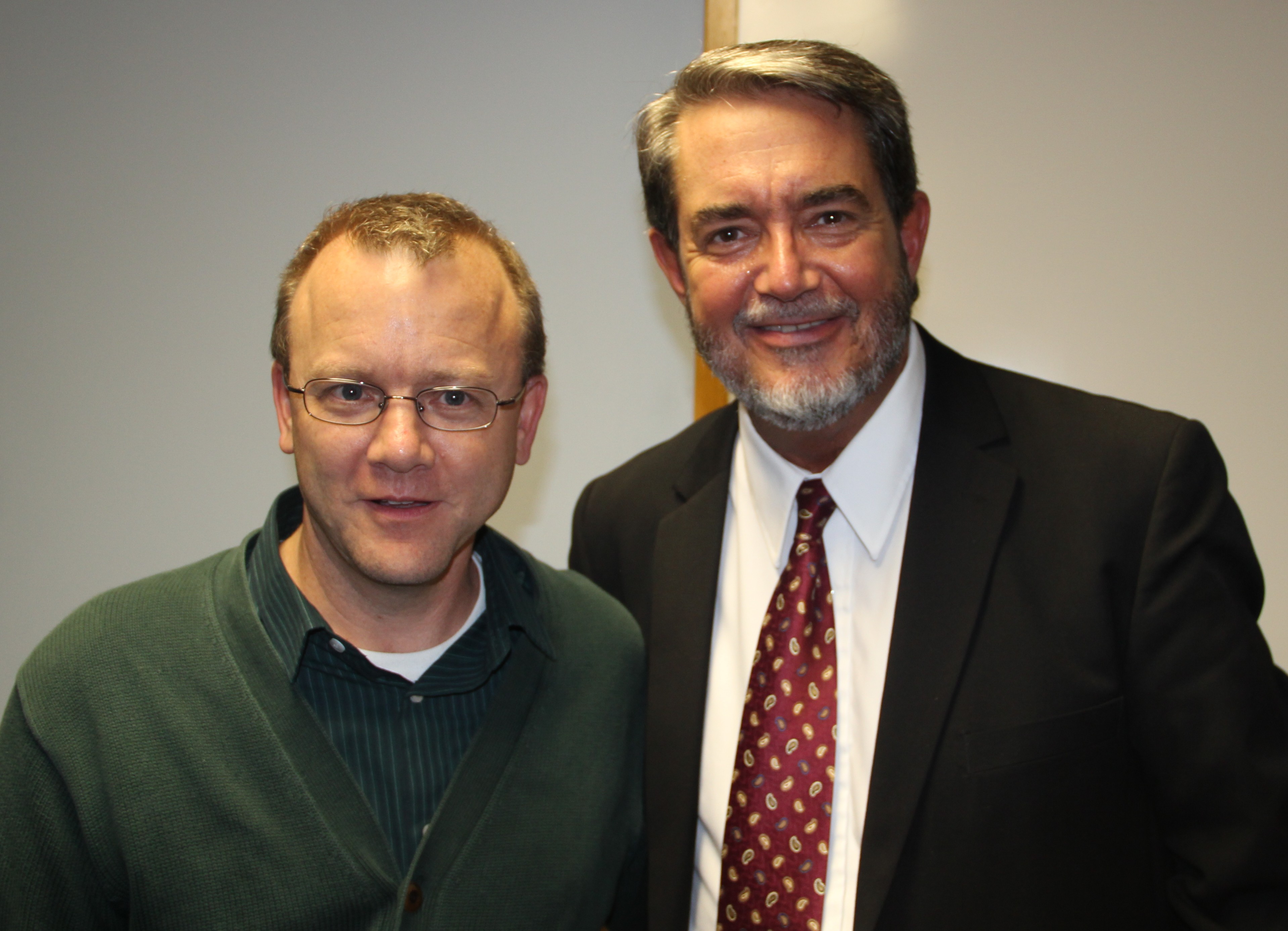
Fast forward again and the point of my post. As many know I enrolled in Christendom College Notre Dame Graduate School this fall working my way toward a Master’s in Theology—-uh Catholic Theology—uh Rather Orthodox Catholic Theology. Only a few weeks into it and the small student body was treated to a visit from none other than Dr. Scott Hahn. Now normally, Dr. Hahn will speak a popular message comprehensible to the laity and those with some biblical understanding. But this special audience got an uncut academic dose based on his new book Politicizing the Bible — a talk which almost went entirely over my head. Let’s just say that while most of the audience gazed on nodding with index finger leaning against the side of their head intellectual like, I stared out like Tennessee Tuxedo’s dimwitted side kick, Chumly, wondering if I should ask Mr. Whoopie. Like listening to a Shakespeare play it takes a while to get your “sea legs” in such matters and in the end I started getting Hahn’s drift.

No doubt Dr. Scott Hahn was extremely influential in my conversion. Although it is rare that people convert based on information alone, at least when God changed my heart, my mind was ready for it.


[1] Read my Far Country bio to understand why

[2] Catholics do not view Catholicism as a denomination. As one author put it, a denomination is defined by ones participation in it.

Dr. Scott Hahn visits NDGS

Dr. Scott Hahn visits NDGS


[1] Read my Far Country bio to understand why

[2] Catholics do not view Catholicism as a denomination. As one author put it, a denomination is defined by ones participation in it.

First day of school

Long ago, before the Punic Wars when I went to college, my decision to go to the University of Maryland was based on practical considerations: I was paying for it, I wasn’t sure what I wanted to do, I could get in-state tuition, and it was driving distance from home. I thought I’d pick English as my major; my hard working father told me to pick again. So I picked Computer Science only to choose Chemical Engineering a semester later followed another change to Electrical Engineering. Eventually I received a B.S. degree from UM followed by an M.S. from JHU both in EE. I proudly display my diplomas in the cardboard tubes in which they were mailed.

Now only a few know that I have enrolled at the Notre Dame Graduate School to start work toward a Masters of Arts degree in Theology. It will probably take forever but no matter: this is something I want to study and it energizes me. Nothing wrong with engineering, but the impetus for learning that craft was duty and economy. My father was right—it has provided me with a very good living over the years. But sooner or later, the DNA of a certain organism will manifest no matter how many plastic surgeries and hormone treatments you give it.

So this week I started my first class—online. Because I am starting at zero, I have to take pre-requisite courses before I can begin to earn credit toward my degree–like I said, this will take forever. The first lecture was in two parts each about an hour in length which I watched over the course of a few days.

So used to secular academic instruction, I was totally blown away by the lecture—not by the topic or the material. What blew me away was the very tail end. After the last point was made and assignments were meted out, the professor crossed himself, bowed in prayer and said the Glory Be. He crossed again and then stepped away from the podium as if nothing unusual just happened. The video went black and I stared at my computer screen remembering that this wasn’t the godless University of Maryland where people of faith were routinely criticized and ridiculed by student and faculty alike. No, this was different—much, much different.

It’s good to be home.

Melkite

My wife, my mom and I attended the Middle Eastern Festival at the Holy Transfiguration Church located in McLean. Aside from crafts, customs and food the festival featured the church itself. It was hard to ignore the number of black robed men with large ornate crucifixes; in fact, a handful sat at our table which was mildly intimidating but I managed to introduce myself to one who, oddly, wore a white robe.

A peek into the dark sanctuary revealed a gallery of gilded icons with a large fresco of Christ overhead. It was tempting to think this must be some Eastern Orthodox Church but, no, this was a Catholic church—a Melkite Greek Catholic Church—that celebrates mass according to the Byzantine Rite and is in full Communion with the Church in Rome. The origins of this Church goes back pretty far, even earlier than the Western Church, having come from regions in the Middle east (Alexandria, Antioch) and from the first communities of the Apostles.

I had heard of this church some time ago when Sigrid, the octogenarian woman that led me to the Church, mentioned it. More recently we ran into a member at a small gathering at a friend’s house last week. Small world, we ran into this gentleman again at the festival. He encouraged us to go to the five o’clock vespers which was an hour later. Mom was excited about going which helped me overcome any hesitation. Kimberly, my wife, was along for it too.

For forty five minutes we stood in the sanctuary and witnessed (and as best we could participated) in a ritual that was likely a jillion years old. It was in English with a few Greek portions (e.g., the Kyrie). There is really no way to explain it since there was so much that was new going on. The priests would chant most of the prayers very rapidly with lots of incense, colors, icons, candles, rituals – it was quite a lot to take in. My mom was overcome by emotion when it started up—indeed there was an immense beauty to it that was striking.

While the prayers were going on full bore, a number of congregants would randomly go up to the front and convene with one of the priests. To us it appeared to be a form of reconciliation which was later confirmed by our friend:

One of priest was hearing confessions in front of the icon. The people usually line up along the right wall and wait their turn. They then approach the priest, usually make 3 bows asking for forgiveness, and say their confession. Then the priest places his stole (representing the yoke, the burden) and says the words of forgiveness “God through Nathan the prophet forgave David his sins; and Peter shedding bitter tears. May this same God, through me, a sinner, forgive you everything in this life and in the life to come. And may he make you stand uncondemned before his awesome judgment-seat, for he is blessed unto ages of ages. Amen” and then the priest removes the stole representing the removal of the burden of sin.

On the left were a cluster of priests chanting and intoning the words of the liturgy without taking a breath. About three would trade off chanting while finger tracing what looked like a musical score set around a rotating stand. Three more would stand in the background occasionally interjecting a prayer. One young priest had his daughter in his arms—yes this Catholic priesthood is allowed to marry and have kids–and what a great legacy that man is leaving his daughter too. [Correction : qualified married men can be ordained as priests but priests cannot marry. I believe this is in accordance with the Roman Church practice too.]

Beyond gilded paneling in the front that one could scarcely see behind, voices would proclaim some of the words and doors would open and close revealing an altar surrounded by candles and icons as well—it was difficult to see. On a number of occasions one of the deacons would wave incense throwing smoke around very generously while walking around the chamber. At one point a team of men walked around baring a high cross while all the congregants tracked their movement with appropriate responsorial.

At the close, everyone was invited to receive a blessing from the priest: we held our overlapped hands open while the priests conferred a blessing—then we would kiss the back of the priest’s hand. Seemed strange, maybe a little unhygienic, but we quickly overcame our fears and went forward.

And then it was over.

And then we went home.

I think I would like to go again.

Infidelity: the necessary appendage of a man of fashion

“Christianity on Trial” by Vincent Carroll & David Shiflett takes on a number of accusations lobbed toward Christians of all sort including (and perhaps especially) Catholics. On the chapter regarding the sanctioning of slavery that the Bible and adherents are accused of, the authors provide the following quote which I found prophetic:

Wilberforce foresaw a “fast approaching” time “when Christianity will be almost as openly disavowed in the language, as in fact it is already supposed to have disappeared from the conduct of men; when infidelity will be held to be the necessary appendage of a man of fashion , and to believe will be deemed the indication of a feeble mind.”

I think we are there.

P.S. If you don’t know who Wm. Wilberforce was, you are probably a modern man of fashion.