Mass Tourism VIII

See introduction to Mass Tourism series here for the motivation behind these essays.

The customary vacation to the OBX brings with it the lack of enthusiasm in going to Mass outside my own parish on a day of obligation. Why? Because going to Mass at either of the two parishes on this protracted island (Redeemer by the Sea in Kitty Hawk and Our Lady of the Seas in Buxton) is a lot like going to a Protestant church, by the sea or elsewhere, in many respects. Other than the recognition that the Eucharist is the body, blood, soul and divinity of Jesus Christ—a deciding factor—-just about everything else co-opts the purest in bankrupt Protestant culture and form.

Architecturally, Redeemer looks like a corporate or municipal facility. Other than a sign that indicates its function, there is nothing outside that signifies it is a sacred place of any make or model. In the strictest of terms it is stark and created for efficient function with frugal economic consideration to boot. It lacks all three of the essential element of classic Catholic Church architecture: 1) Permanence. It could be defended that anything on OBX will be swept into the ocean but still I have been in beach houses of higher quality. 2) Verticality. No doubt the Wright Brothers Memorial wins the loftiness prize hereabouts but it’s not too much to ask that the edifice face the rising sun in some awe-inspiring way especially when you have “by the sea” in your name (which is a misnomer since it is on the west side of the coastal highway “by the muffler shop” but that’s not as spiritual). 3) Iconography. A crude, unhewn wood cross draped with white linen was all that presented on the front; stations of the cross were seen high up on the back wall far out of sight. That’s it. No corpus, no crucifix, no tabernacle, no graven images, and absolutely artless in the extreme. Even the pews had a coarse functionality—thick wood benches made of scratched planking. This edifice was designed for one thing: a large throng of Tommy Bahamas to show up alongside regular parishioners during the on season.

Our Lady in Buxton is considerably better with a Rosary Garden, outdoor stations of the Cross, unique Italian woodcarving of Our Lady by the Sea, and an interior wooden architecture with small flying buttresses on the outside (a peculiar idea since the pointed arches of the interior are not about to collapse under tons of stone). Unlike Redeemer, this building is actually by a body of water, the sound, which shows nicely as a sharp line through the large clear windows behind the altar. Sadly, the altar—the most central element of the Mass and Catholic Church building—is the biggest piece of kitsch I’ve ever seen in a sacred space: a rectangular white slab atop a turquoise cresting wave carrying way too far the beachy-by-the-sea theme. There is a tabernacle nailed to the wall off to the side albeit one designed by IKEA and void of symbolism.

This vacation I visited Redeemer whcih, liturgically, was more like a non-denominational Bible Church than a Catholic Mass. The solemn, silent sentiment conducive of prayer and preparation as one knelled in the sanctuary after entering was replaced with social marketplace clamor bordering on mayhem. We opened by greeting one another and introducing ourselves under the priest’s directive. I went beyond the call of duty to ask the guy behind me where he was from, testing the idea that most people in attendance were from out of town like me. Alas, no, the poor man lived on the other side of the bridge and this was his parish church, week after insufferable week.

But there is always the Novus Ordo to rely on, right? I held the laminated card ready to respond in English the long pieces I know better in Latin. Interestingly, some of the printed responses had the Latin heading. But the laminated card was unnecessary. The Confiteor was replaced with a silent private reflection; the Gloria was sung in the kindergarten style that I dread; the Credo was replaced with a renewal of baptismal vows which I’d never heard was an option; we held hands during the Our Father; we remained standing throughout communion; we lifted our hands Pentacostal like toward all the mothers being blessed on this Mother’s Day; the Mass ended without the prayer to St. Michael. And the marketplace clamor that started the service resumed on the last note of the recessional.

This and similar experiences correlate with significant spiritual changes afoot in the household. Since the beginning of the year Kimberly has been attending services and adult education classes at Holy Transfiguration, Greek Catholic Melkite church in McLean. Through several intersections, we had had encounters with HT that sustained more than a mild interest over the years. Considering that Melkites total 1.5 million people worldwide in comparison to 1.2 billion Roman Catholics, these encounters may be more than fortuitous.

And during this time, on the Saturday before Ash Wednesday I awoke early in the morning in excruciating pain.  Before the day was over I was on pain killers, anti-inflammatories, muscle relaxers and prednisone. An MRI on Fat Tuesday showed disc deterioration and severe nerve impact to my left arm and hand which had lost function. I was unable to drive myself to work or Mass or anywhere. I had to cancel a much-anticipated trip with my daughter to Reykjavik. Navigating the medical options was bewildering but after some weeks and second opinions came to a hard decision. One month after the initial episode I was undergoing surgery for anterior cervical discectomy and fusion (ACDF) followed by recovery. Along the way, a so-called blizzard in an otherwise tame winter delayed getting a second opinion; a Leyland cypress fell in the yard; my dog started bleeding from the anus; the clothes dryer died; the outlet receptacle was wrong; my car needed a new fuel pump even though I wasn’t driving Brother Jerome anywhere. For the entirety of Lent I was homebound and my only spiritual outlet was HT through Kimberly. Why my own parish would not or could not come to provide communion or moral support is both a mystery and another story.

In any case, I have been exposed more and more to Orthodox teaching (just finishing Timothy Ware’s Orthodox Church) which in many ways lumps the experience of Western Christianity be it Roman Catholic or Protestant into one pot of common history, never mind that there were once at each other’s throats. But the problem that I often see, and the Orthodox point out, is the taint of Protestantism in the Roman Catholic Church as is evident in many parishes like Redeemer by the Sea. It’s astounding how many Catholics I encounter who act Protestant in every manner, or, if they indeed ascribe to all magisterial teaching, have no idea what or why. And from my own Mass tourism, Catholic Parishes have less regard for the sacred, the tradition, or the patrimony of their own Roman Catholic Church and the Reformers seem to have made an indelible mark in modern Catholic architecture, theology, liturgy, art and thought.

Such things have not occurred in the vein of the Orthodox which developed their own history after schism in 1054. Their teaching highly coheres with Roman Catholicism with many of the differences favoring the Orthodox in my humble estimation. Whereas Roman Catholicism as evolved to be monarchical and juridical, the Orthodox have evolved to be collegial and liturgical.

I suppose I have been lucky to have been introduced to an orthodox form of Roman Catholicism which, as it turns out, is rare. It may be a fait accompli that I will cross the Mediterranean and become Melkite; Kimberly has already decided and will be chrismated next month and will be entering the Catholic Church through the eastern door. I could not be happier and I can’t help see that clearly God’s hand has been in this more than my own. During a radio interview with Peter Kreeft, a man like myself called in to ask about his wife who had not followed the caller into the catholic church from a Protestant tradition. Kreeft deftly responded: “You are introducing your wife to the true Church, she is introducing you to the true faith; be patient.”

I am not exactly sure what Kreeft meant but it I think it applies to me. Stay tuned.
The Legitimacy of Presidency

I find it reprehensible in the extreme that some members of Congress are boycotting the inauguration, claiming that Donald Trump’s election to the office is illegitimate. Especially at a time when national unity is needed and the inauguration presents an opportunity to go forward, this is egregiously bad partisan behavior and the reason why Donald Trump became president in the first place—for better or for worse. Washington is still broken yet many leaders continue to fiddle during the conflagration.

The surrounding rhetoric reminisces of the claim some made regarding Barak Obama’s Presidency being illegitimate dues to his birth status. So-called “birthers” were ridiculed for the straw grasping attempt to reverse the results of the election. But now the shoe is simply on the other foot. And as In either case the perpetrators should be derided and ridiculed and vilified. And those members of Congress that boycotted the election should be tossed out of office by their constituents—I predict they will be. I can’t imagine their constituency seriously cares about the so-called conscience of their congressman when they themselves struggle with insurance, bills and a convoluted tax code—and probably voted for Donald Trump. They want Congress to work together to get the country’s business done.

Now if hacking by a foreign adversary shaped the election by electronically altering vote tallies—I would be the first to agree that the election results are invalid. But, as far as any one knows—and this is the same extent that anyone knows Hillary Clinton’s email server was infected with malware—adversaries were not able to electronically alter vote tallies. Though there were embarrassing emails and unwanted revelations, the facts of the matter remain:

  • Voters voted the way they voted—no one pulled the lever or pushed the button for them. Whatever the motive for voting the way they voted, one can speculate forever and it’s irrelevant. There are any number of absurd reasons why people vote the way they do yet no one’s decision is qualified.
  • Embarrassing leaks that shaped the election? What else is new. Mitt Romney’s relatively benign audio leak cost him the election yet no one called the winner illegitimate. Donald Trump’s locker room banter might have cost him the election and if it did, would some in Congress boycott the inauguration of Hillary Clinton? Doubt it. This sort of thing has become the name of the game whether it came from Wiki-Leaks, Russia, China or Mother Jones.
  • What power does wiki leaks have that wasn’t given to them by conduct? If Donna Brazile gave Hillary Clinton town hall questions ahead of the event, imagine if Hillary Clinton declined to receive them. Imagine being beyond reproach. Imagine treating people with respect both on and off camera, on and off line. More than ever, politicians must comport themselves as if everyone can hear, read, and see all that they do, even if there is an assumption of confidentiality.

It’s time to get to work without politics as usual. Let the new administration get started. And let Congress get back to work.


Freising and the Feast Day of St. Korbinian

On our second to last day of vacation we planned to spend the night in Munich near the airport to alleviate the travel burden. For no other reason than proximity and price, Kimberly reserved us a hotel room at an old historic hotel in Freising which was an 800 m walk from the train station. Since the next day was Sunday, she figured I could go to Mass at the historic church central to the old European town.

Now all this turned out to be providential in the extreme. After dropping off our luggage we ventured around the cobblestone streets looking for a place to eat and to reconnoiter the church that I would visit early the next morning. The moment we got outside, church bells sounded and echoed from all directions. I thought it was simply signaling the hour but the clamor continued for over twenty minutes. I remember thinking, “does this happen every hour?” Seemed like such a frequent usage of the bells would take the charm out of it but maybe the townspeople have zoned it out of their mind and hearing.

Rain started to fall and the streets seem to empty has if a siesta had set in which, at about 2 PM, might have been reasonable were this not Germany. We walked along stumbling up steep cobblestone streets and narrow passages. The grounds of the church seemed empty advertising an “after hours” feeling. I just wanted to get a glimpse and see if Mass times were posted. Drawing closer we could hear some singing and faint music—probably choir practice.

We found what was the large wooden “front door” and Kimberly creaked it open, peaked in, looked around and walked through. I followed.

What I saw was not what I expected (a mostly empty church with plain clothes chorister singing in some corner). Not nearly: the expansive church was packed with people, many standing on the steps and back entry way. At the back was a huge raised area lined with clergy and at the head sat three seated men with vestments and large miters. Was this a Mass in the middle of the day? What is going on in here?

What we discovered was a celebration of the Feast Day of Saint Korbinian, patron of the city and the Freising-Munich diocese overall. This was not some old magnificent Church and monastery, but the very Cathedral and chair of the bishop—the same bishopric once shepherded by Joseph Ratzinger (Pope Benedict XVI). My undaunted wife marched up to the gallery where we sat overlooking the expanse of the Cathedral right next to the organ / orchestra loft. The whole ritual was saturated in the most glorious and sacred of music.  Before the altar at the bottom of the steps was what appeared to be the reliquary of Saint Korbinian himself which underwent an incensing and a walk around the sanctuary with a huge procession of bishops, priests and altar kids. As the bishop walked behind it, he laid hands on all the children for blessing. Others handed out medals, presumably of the saint, to any kid who wanted one—and who did not want one? Heck, I wanted one.

We were there for at least an hour and the “service” ended with the Salve Regina sung in the same tune we sing at St. Catherine. Of course I joined in—it was astounding.

Mass Tourism VII – St. Sebastian, Garmisch-Partenkirchen

See introduction to Mass Tourism series here for the motivation behind these essays.

_dsc7169

_dsc7177

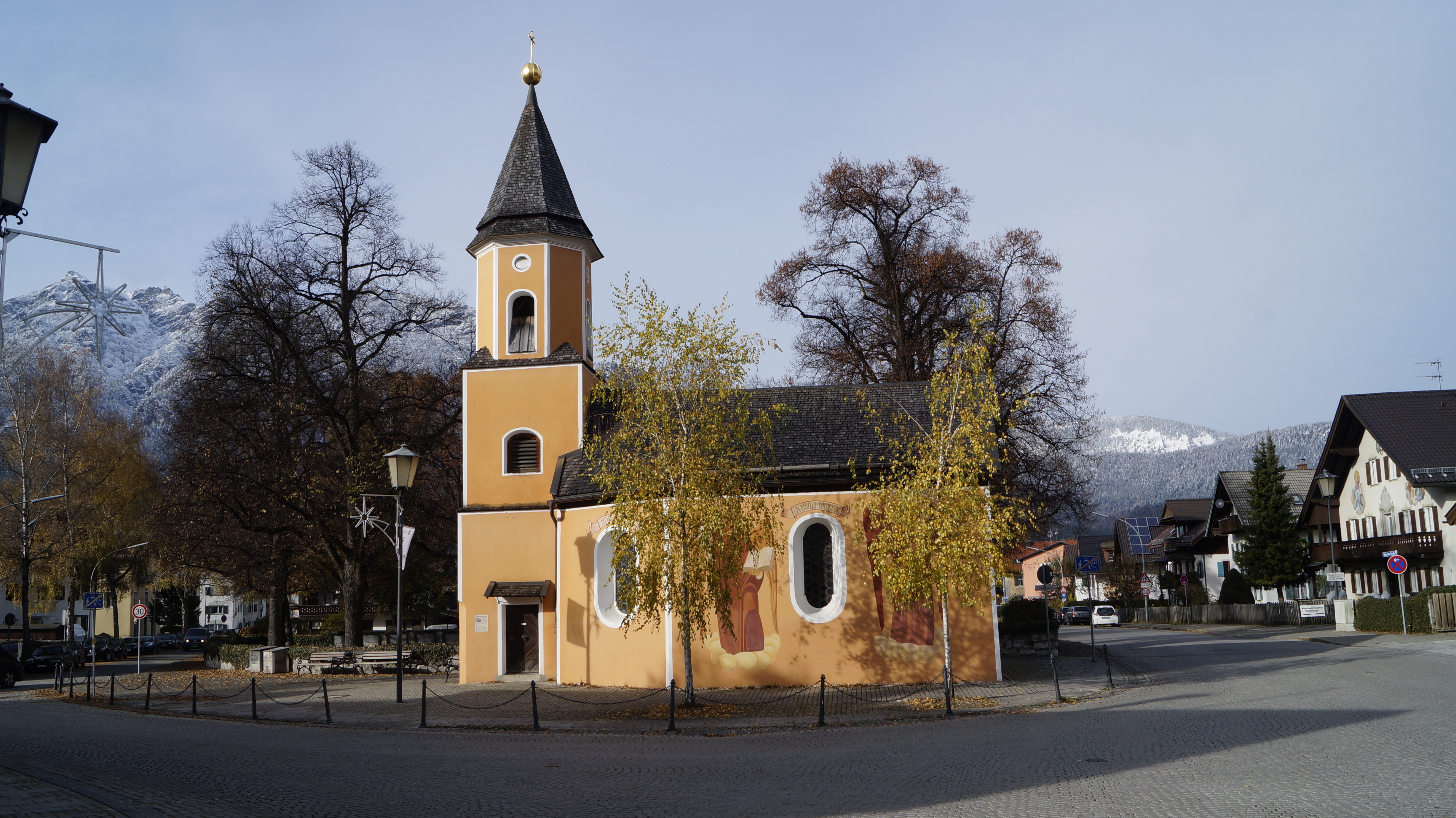
Sunday morning (Nov 13), I left to attend St. Sebastian which posted a Latin Mass time of 10 AM. This tiny chapel in the middle of town at a sharp turn on the historic Ludwigstraße was built in 17th century and is the oldest church in Garmisch, if not the oldest building there altogether. All psyched up to attend Mass in a foreign country with no ability to “low-profile”, I arrived at the door which was locked shut. Peering through the dark windows, it seemed no one was there. A note tacked to the door revealed the situation, albeit in German. I was sure it stated that the Mass was postponed to 6PM. Nevertheless, I waited until the prescribed hour before returning to the apartment.

I decided to stop by the Netto market for bread but, wouldn’t you know, it was closed Sunday as were most businesses. Once upon a time it was true in America (and still in some towns)—that Sunday was a holy day of rest and one managed to reckon that fact into the week.

[Aside: Imbued by the culture, I have come to expect that stores will be open 24/7 for my convenience. I am convicted of the idea that we should return to a Closed-Sunday culture if not for religious purposes, but simply for the health and sanity of American society warped on money-making. Once attending a travel soccer game far away in Charlottesville, another father who I usually sat with was mocking the idea that local stores would be closed on Sunday for religious purposes (e.g. Chic-Fil-A). I just smirked in response but what I really wanted to say was, “You jerk! Do you think other families would like to spend time together at least one day of the week like you do? Is it so important that you get your hamburger value meal and a venti coffee at any hour of your life that others must scratch out a meager living to accommodate your every wish?” But I relented since I don’t exactly boycott businesses on Sunday myself.]

I returned to the chapel at the re-appointed time when all was dark and the streets were mostly empty. This time the chapel was open and some people had shown up. As I entered through the old wooden door, I immediately remember what Sigrid had told me, that there would be a group of people saying the rosary. I listened intently to determine what prayer was being uttered in German. The Fatima prayer almost sounded like the English version.

The chapel is very small, about 8 rows of pew split with a center aisle, each side wide enough to seat 3-4 people. There was absolutely nothing ergonomic about the sitting, the old pews possibly designed for function alone and no comfort—perhaps even mortification. I was forced to sit completely erect as the back rest shot a straight vertical with a seat slightly better than a 2×4 plank. Kneeling was no better, the kneeler raised so high, my feet could not touch the ground and my upper body ready to topple over the pew in front of me.

At the head of the church, the tabernacle was positioned tightly to the left side of the altar as if space would only allow that location. Above the altar was an old darkened painting of St. Sebastian, characteristically riddled with arrows and a doleful look heavenward.

Two priests entered through a side door, the celebrant being a man very young—around thirty—not something I imagine when I think of a Catholic priest. It was not just in my head that he fixed a prolonged stare on me–the oddity in this small chapel of senior women. Who let the American riff-raff in?

Ah but I had prepared my missal for this moment, reckoning that it was the 26th Sunday of Pentecost and my kindle at the ready with highlights. Mass started with Asperges, the traditional rite of sprinkling holy water on the congregation while the same traditional introit hymn is sung. The pews had been provisioned with a gray book Gotteslob which I saw in every church in Germany—an all-purpose book for the new liturgy and hymns. This chapel, however, had an additional small green booklet that was the hymns and responses for the High Latin Mass. For the most part, the Mass followed the words in my electronic Missal for the appointed day. Those parts where I was versed in the response, e.g. “Domine, non sum dignus ut intres sub tectum meum…” I made sure I was clearly heard so that everyone could be at ease that I just did not stumble into their singular worship service after touring Ludwigstraße purchasing bratwurst and souvenirs. American Riff-raff my foot!

Communion was kneeling at a 4-person altar rail which took all of 2 minutes. In this form of the Mass the communicant does not say Amen or anything—just quietly take the consecrated bread by mouth. I received the Eucharist in my mouth which I wasn’t nervous about. I think kneeling to take communion at an altar rail provides a certain level of security.

I meandered out of the Chapel after the final hymn. Waiting outside was the man sitting behind me. He was a distance from the door as if waiting for his spouse to pop out so that they could go home–typical. He looked at my brightly, “Guten Nacht.” I smiled and responded the same in my feeble German as I turned to go back to the apartment in the opposite direction.

Garmische-Partenkirchen

Kimberly and I are in Europe, combining our 25th anniversary, pilgrimage, and an opportunity to stay at a friend’s apartment in Garmisch-Partenkirchen. And now I can see why my friend abides here several times throughout the year. It is astoundingly beautiful with Zugspitze and other towering alpine peaks guarding the town on all sides, its historic cobblestone Ludwigstraße with restaurants and shops, and the handsomely built Bavarian homes with dark wood accents, gable carvings, tiled roofs and white stucco walls. Indeed, Garmisch-Partenkirchen looks like the place Busch Gardens tried to pretentiously replicate in their theme parks.

But Garmisch-Partenkirchen has a deeper beauty Busch Gardens could nor would ever attempt to replicate, a beauty forged from centuries of tradition and spirituality that calls from an integrated Papal Christian Europe.  On walls and in windows, be it a home, hotel or bakery, are crosses (cum corpore), statues, and images depicting Jesus, the Virgin Mary, Apostles, saints, or scenes from the Bible. In backyards, amid fields, and along roads are numerous small gabled shrines of the crucified Christ. These are created in the artistic tradition of the West to forever proclaim the gospel to an illiterate world, not because Gutenberg had yet to mass produce books centuries ago, but because Zuckerberg has mass produced social media on Facebook in our own day, heralding another dark age in which knowledge is not burned by the barbarian hordes, but buried in the big-data deluge of the mundane and meaningless.

Even in the local language, there is an unabashed and unbuffered perspective on life and the eternal. Around here one may say “Guten Tag” or “Auf Wiedersehen” but it is often to hear “Grüße Gott” which I believe literally means “God’s Greetings”. Imagining such fixtures in the United States, the images would be defaced, the monuments would be removed by judiciary, the businesses would be boycotted, the greeting would be met with scorn or rebuke. Consequently, we have no culture, no identity, no conviction and no truth. We have only power and the world view of those that wield it. As Hillaire Belloc stated in his book Characters of the Reformation: “The religion of the government becomes the religion of the state.” Is he wrong?

The Reformation (or at least the ultimate manifestation of it) roughly divided Germany into the Catholic south and Protestant North. This was more political than religious and resulted in state religions (the Church of ENGLAND, the Church of NORWAY, the Church of DENMARK to illustrate the point). In Germany (then the Holy Roman Empire) it was the religion adopted by the prince in whatever principality or territory ruled over. For the ordinary subject that meant adopting the prince’s world view or have a rough life of persecution to look forward to.

CUT TO: The United States of America where, supposedly, there is no official State Religion by Constitution. It sounds great on paper but in practice it has evolved to be the same thing as Old Europe.  If I don’t embrace the administration’s stance on faith and morals (homosexuality, same-sex marriage, abortion) I can expect legal or financial persecution: no federal funding for schools that are not on board with trans-gender bathrooms; no tax exemption for churches that preach against the power of the state; severe penalties if I object to selling abortifacient drugs; total annihilation if I don’t use my business in support of a same-sex wedding ceremony.

So I ask again, is Belloc wrong?

I Protested

I voted protested.

This is in response to those who, disappointed with the presidential election results, are either protesting in the streets or packing bags to move to another country. To those peoples I say, stop what you are doing, for such actions reveals how you regard democratic ideals—the ideals which the U.S. has attempted to “export” to the countries to which you flee.

In full disclosure, I did not, repeat DID NOT, vote for Donald Trump. My candidate lost. I knew my candidate would lose, for I voted for a third-party candidate of which most people never heard. Indeed, the party I voted for was so small and obscure, I had to write it in (although my state supposedly tallied those votes as if it were listed).

It has been said that, in voting third party as a conservative, I virtually voted for Hillary Clinton. Supposing this is true, well then my selection lost twice.  It was also said that my vote was wasted and thrown away. But I voted the way I voted, not just to deny the major party candidates, but to protest the media’s election-shaping from beginning to end, first elevating Trump to the nomination with jillions of dollars of free exposure and elevating Clinton to the nomination with judicious reporting (and CNN cheating via Donna Brazille). The presidential debates further shaped the binary choice with irrelevant questions designed to highlight each candidate’s lack of morality—hey, tell me something new. I see reason that the same air time could have been used to include third party candidate’s responses on issues that would affect me if they enter office.  But the media had decided that TWO is the number of the counting and the number of the counting shall be TWO!

But now the strange reality: Donald Trump is president elect. If protestors protest that fact, who or what could change it? That the presidency should be simply handed over to Clinton? Why not the party I voted for who also lost?

We have an election every four years to register our protest—our revolt. The nation protested the establishment in a huge way; the nation protested the usual politics and politicians. The nation protested at the ballot box, for better or for worse. If one believes using some sort of force to remove Donald Trump from power, you are basically saying you want to change our Constitution and our form of government. Do you really? Do you want to disenfranchise a segment of the population? Shall we go back to 1 acre = 1 vote? How about white, male, landowners? If you are protesting in the street or flying off to Canada, can you say you believe in democracy? Yes, I think we should only allow people the right to vote but only if they agree with my politics. Sound good?

The bottom line: democracy requires that 1) I participate by voting 2) I accept the results. Agreed that the first one assumes one is making an informed choice but the media has made that difficult to do. The second is more unilateral. If I were to protest anything it would be the vetting we use to arrive at the candidates we get from which the president is elected. But as it stands, we must accept the results or renounce our Constitution altogether. Personally, I was fully prepared to accept a Clinton presidency—indeed it seemed like a foregone conclusion. But now it is a Trump presidency and the only proper thing to do is to accept that fact, get behind him, and move on.

Incarnational Religion

Catholicism is often described as an “incarnational religion”. On several fronts, this presents a huge paradigm shift from Protestant Christianity to include non-denominational Bible Christianity.

In the first place, the word religion is not considered a negative term in the Church as it is in other traditions—specifically Bible churches. Apparently, no one likes to be called “religious” these days and modern, so-called relevant, Christians like to distance themselves from “organized religion”. The far edge of this thinking lays claim to being spiritual but not religious which means no one tells me what to believe. Gaze at your own navel, meditate on your own breathing, but don’t stand on the shoulders of giants like St. Paul, St. Jerome, St. Augustine, St. Thomas Aquinas, and other byproducts of so-called organized, systematic, developed r***g**n.

But the Bible is not inimical to the idea of religion (a particular system of faith and worship), detailing such from cover to cover. The Epistle of James even mentions the word religion, specifically that which is vain versus that which is good:

James 1:26 If any one thinks he is religious, and does not bridle his tongue but deceives his heart, this man’s religion is vain. 27 Religion that is pure and undefiled before God and the Father is this: to visit orphans and widows in their affliction, and to keep oneself unstained from the world.

So religion per se is not bad, and avoiding the word “religion” in matters of faith and morals is like an atheist avoiding the word “design” in matters of life. It’s absurd.

So what is this “incarnational religion”?

The word incarnational describes the divine manifested in the physical world, specifically manifested in human flesh. It is derived from the same vocabulary as “carnivore” (flesh eating), “carnival” (indulging the flesh), and, lest we forget, “chili con carne” (chili with meat).

When the New Testament speaks of the Word (Jesus Christ) becoming flesh, specifically in John’s Gospel and Letters, it references the doctrine practically unique to Christianity—that God became Man at a verifiable point in space and time. This mystery has been pondered, debated, wrangled, and even rejected over the course of millennia—a difficult teaching to accept by our finite, faithless and fallen world:

John 1:1 In beginning was the Word, and the Word was with God, and the Word was God. 2 He was in the beginning with God; 3 all things were made through him, and without him was not anything made that was made. 4 In him was life, and the life was the light of men. 5 The light shines in the darkness, and the darkness has not overcome it. …9 The true light that enlightens every man was coming into the world. 10 He was in the world, and the world was made through him, yet the world knew him not.

The Church repeats this mystery in many of her prayers and liturgical formulas. At this point of the Credo, all are to bow:

et incarnatus est de Spiritu Sancto ex Maria Virgine, et homo factus est. (and he became flesh by the Holy Spirit out of the Virgin Mary, and he was made man)

immediately followed by

crucifixus etiam pro nobis sub Pontio Pilato (also he was crucified for us under (the rule of) Pontius Pilate)

Not to specifically disrespect Pontius Pilate but to draw attention to the incarnation of God Almighty being not some vague event that happened in the minds of anonymous myth-makers but a point in world history that can be reckoned by anyone with a calendar. The Roman Empire existed, the governor of Judea existed, and Pontius Pilate was known to exist even memorialized by a marble block found in Caesarea inscribed with his unfortunate name: PONTIVS PILATVS.

Later in the Mass, the priest will elevate the fracture host toward the people and proclaim

Ecce Agnus Dei, ecce qui tollit peccata mundi. Beati qui ad cenam Agni vocati sunt (behold the lamb of God, behold he who takes away the sin of the world. Blessed are they that are called to the supper of the lamb)

We hear it, we see it, and soon thereafter we will gnaw upon the body and blood of Christ—yes, a very incarnate religion.

In numerous other ways, the liturgy of the Mass draws from the physical aspects of the world be it water, wine, oil, bread, incense, iconography, statuary, architecture, stained glass, images, bells, chant, vestments, candles, fire, gold, metal, cloth, gesture, touch—-all the physical senses engaged—and likely why they were created. In fact, Catholic thought, teaching, and sacramental life draw from the properties of our temporal world to include marriage, sexuality, harvest, agriculture, seasons, calendar, ritual, language, and human culture.

The bottom line: Catholicism recognizes the world as not something that is simply “fallen” and thereby “worthless” but draws from nature and the works of the Creator as inherently good.  After each act of creation in Genesis, we read “And God saw that it was good”—not wicked, not disposable, not deplorable. Furthermore, creation serves as the instruments of worship and the primary reason why it and we were created in the first place. Intelligent human beings are the ones qualified to worship God since true worship requires an independent act of one’s directed will. The sacrificial system of worship that fell to the fallen world (via Israel) required material offerings as well as spirit, words, and deed. And the sacrifice of the Mass presents none other than the acceptable body, blood, soul and divinity of the unblemished INCARNATE Christ. The Eucharist is the physical sign of the New and Everlasting Covenant which followed the material signs that marked all previous covenants: Sabbath (Adamic), rainbow (Noahic), circumcision (Abrahamic), Passover (Mosaic), kingdom (Davidic) all of which miraculously persist in the modern world.

This incarnational property of the Catholic Church allows it to regard wine, beer, whisky, tobacco and gambling as things that are not inherently bad but properties of God’s “good” creation that, like sex and eating, can be enjoyed as gifts or misused in sin.

Because of this aspect, the Church is often indicted on the grounds of hailing from pagan influence. But where exactly does the counter idea originate, the idea that the temporal physical world, the flesh, the body, etc. is bad? It is a pagan idea and a perspective, I will argue, that finds certain harbor in Protestant Christianity.

Enter ancient Greece.  The Greek version of a beatific vision sought to liberate man from the prison of his body which the Greek equated with the world and with death. The purpose of pagan Greek religion was to release the soul imprisoned in the tomb of the body constrained by worldly distractions. And the purpose of the ancient Greek was to make sure everyone complied through oppressive taxation and cultural subjugation (ref: Democrat party). Whatever Hellenizing sought to do philosophically, the policy began to unify the ancient world in language and culture in the wake of Alexander the Great.

So what does that sound like? Catholicism or Protestantism? When we cast away the trapping of the world including our own human body and souls as inherently wrong or evil, this teaching, over time, evolved to eliminate from Christian Europe and the West many things including:

  • Sacraments (other than baptism)
  • Iconography (Reformers destroying churches in the 16th century) and the desolation of monasteries (Henry VIII).
  • The crucifix without a corpus
  • Transubstantiation
  • Wine (commercially substituted by Welch’s grape juice, still)
  • Any effort toward a temporal righteousness involving deeds (the arm of the flesh).

[ Added Oct 17 ] Here is a quote from Hillaire Belloc’s Characters of the Reformation. In this segment on Oliver Cromwell, Belloc defines the new Protestant faction of Puritanism:

The sentiment rather than the conviction that the material world is evil, and therefore that all sensual joy is in essence evil, lies at the root of Puritanism. Joy in the arts, delight in beauty, and the rest of it, are the Puritan’s object of hatred. He sees them all as rivals to the majesty of God and obstacles which deflect the pure worship of that majesty. It has been remarked as a curious by-product of Puritanism that it threw men back on to the pursuit of wealth as their main occupation. It is from Puritanism that we derive modern industrial capitalism, the centralization of wealth in a few hands, the dispossession of the masses and their exploitation by a small number of those who control the means of production; all that we call Capitalism. 

As another postscript, I wonder if the surge in New Age religions, Wicca or the popularity of Magic in media (Harry Potter, Once Upon a Time, Merlin) is due in part to a suppressed human need to incorporate the material world in worship and in religion.  In any case, relegating the physical world to the domain of inherent evil is inherently false and inherently pagan.

Mass Tourism VI – Time Traveler Edition

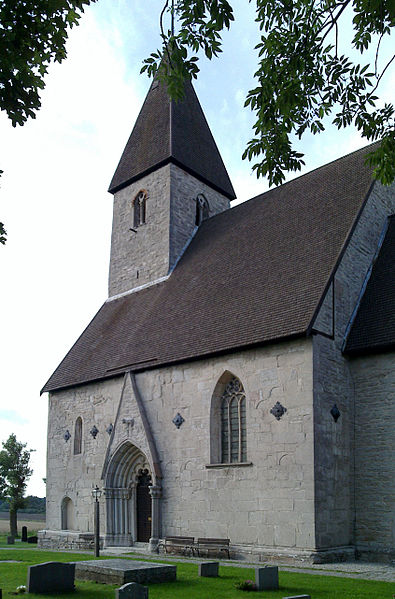
395px-endre-kyrka-gotland-torn3

See introduction to Mass Tourism series here for the motivation behind these essays.

This week I did not visit a local parish or go to Mass while on vacation. I did not participate in some Eastern rite of the Catholic Church as I am wont to do. No, this time I went to the small Endre parish— located one mile east of Visby on the island of Gotland, Sweden built in the 12th century—where Fr. Anders Piltz celebrated the Holy Sacrifice of the Mass on October 5, 1450, the 18th Sunday after Pentecost, many years before the Protestant Reformation.

Fortunately, I was somewhat prepared, having studied the traditional rite as it was celebrated for 400 years from the Council of Trent to Vatican II. But this was even before the establishment of the Tridentine Mass and there are several differences.

Endre has distinctly older components, specifically a rood screen that separates the people from the priests and all liturgical activity. It is only until communion that the faithful cross into the sanctuary to receive the consecrated bread kneeling down. A small version of what looked like an iconostasis stood above the altar.  Thin narrow stained glass windows punctuated the front and sides of the sanctuary. A roughly crafted crucifix hung under the pointed Gothic arch in front of the public area. The nave was walled solid with fading frescoes. A dull, cacophonous bell was sounded at the usual parts of the ritual.

The rite was, of course, in Latin and many of the liturgical formulas (Gloria, Credo, Sorsum corda, Sanctus, Agnus Dei) are exactly the same as we use in the current Novus Ordo Latin rite although the responses were not provided by the people but by a professional cantor. Some responses were not evident, such as the Confiteor or Suscipiat. The vesting prayers I could not equate to those I studied in Latin class but I understand these can vary. The Mass readings and specific prayers for that Sunday in the liturgical calendar adhered to the 1962 Roman Missal I possessed. The priest stood ad orientem as was the norm prior to Vatican II and is presently being revived. The incensing of the altar and then toward the people prior to the Liturgy of the Eucharist is exactly as is done at St. Catherine’s most Sundays. Much of the intonation was barely audible as parts were conducted discretely. This was the practice for centuries—the sacredness and mystery of transubstantiation was too prone to misunderstanding and vulgarization, and catechumens were dismissed before the Eucharistic Liturgy as a precaution.

Even though the liturgy of the Mass has changed, it’s astounding just how much of it is still intact and recognizable over five and half centuries later including an overhaul of the rite in the early 1960’s. Should you also wish to travel back in time and witness what Mass was like to ordinary people, simply click here.

And bring an old missal.

Great Cloud of Witnesses

As mentioned in the series called Paradigm shifts, the Catholic Church believes that the Church is made up of three major parts: The Church Militant, the Church Expectant, and the Church Triumphant. The first are those Christians waging spiritual warfare here on Earth, while the last is that standing in the presence of God interceding on the Church’s behalf. The penitent Church in the middle is that in purgatory.

When we read Hebrews 12:1 about a great cloud of witnesses, Church teaching understands this to mean the communion of saints, particularly the Church triumphant whose righteous prayers avail on our behalf. The author of the Hebrews recounts some of these witnesses including Abel, Enoch, Noah, Abraham, Moses, David and others.

12  Therefore, since we are surrounded by so great a cloud of witnesses, let us also lay aside every weight, and sin which clings so closely, and let us run with perseverance the race that is set before us, * 2 looking to Jesus the pioneer and perfecter of our faith, who for the joy that was set before him endured the cross, despising the shame, and is seated at the right hand of the throne of God.

One analogy is to see these communion of saints in the heavenly realm cheering us on as if we are in some sort of marathon or sporting event running toward the finish line.  This correlates with Paul’s analogy in 1 Cor 9:24

24 Do you not know that in a race all the runners compete, but only one receives the prize? So run that you may obtain it. 25 Every athlete exercises self-control in all things. They do it to receive a perishable wreath, but we an imperishable. 26 Well, I do not run aimlessly, I do not box as one beating the air; 27 but I pommel my body and subdue it, lest after preaching to others I myself should be disqualified.

I tend to think of the communion of saints in different terms, not as an active cheering section but a model of leadership as expressed in their Earthly life. Despite the gates of Hell prevailing on the world in which they lived, the saints (Church triumphant) prove that men and women like you and me can run the race and win. Maximillian Kolbe, Theresa of Calcutta, Thomas More, Martin Pascual, and countless others (including Peter, Paul, .. Cosmae, Damian, … Lucy, Agnes and those declared in the Canon of the Mass).

The image of St. Thomas More hangs on the wall above my computer in my home office to remind me that not all men have a price. The image of Martin Pascual is uploaded on this blog (see Hagiography) as a reminder to me that there is a life that transcends this one and we can meet our end with that reality painted on our face. I don’t mind that they may be cheering me on and praying on my behalf, but I view their life as one that I too can emulate, and, God willing (yes, with my participation), I too will subordinate the worldly pull for a greater prize.  The Communion of the Saints is not just doctrine I adhere to as one of the faithful, but it is just one of the many great treasures of the Church I possess as my patrimony and that of all Christians should they accept it.

Dear Neighbor

My representative in Congress sent me a letter. I respond in this post, a response I never sent to him since I don’t think he would read it or would it make a wit of difference.


Dear Honorable Congressman Gerry Connolly,

Thank you for your letter. I was somewhat surprised to see it. To be honest, I harbor serious doubt about your intention to reach out and address my concerns. Once upon a time I was somewhat active in communicating my thoughts to my representatives but that has more or less ended. My queries have not been answered, my concerns have not been addressed, and those in power appear to answer to no one. I took a great deal of time to write this response if for only therapeutic reasons; but if you are seriously concerned, you will read it.

Congressman, it is much, much worse than just a lack of cooperation, civility, common ground, or common sense at the highest levels of leadership and governance that you wrote about in your letter. And it is more tragic still that many of our problems have simple and elegant solutions. But that does not matter to a people that just want what they want—truth, law, rights, civility and all celestial beings be damned. And what the people want—you give them—not in a spirit of cooperation and progress toward an objective truth—but in a spirit of expediency and self-interest. Like Hamlet, Othello, and Macbeth, our uncontrolled passions will lead us to our tragic demise. And rather than lead, our leaders simply follow.

I can go on how disappointed I am with the policies and edicts emitted by all three branches of our government—the three branches that are to check and balance each other as our forefathers designed and not the three ring circus it has become.  But instead I will give you a prescription and how you can unilaterally begin to remedy these Divided States of America—if you care. Here they are:

Build Trust

The Speed of Trust is a book by Stephen M. R. Covey that reveals how companies that create and maintain a high trust environment accomplish their business goals and mission with speed and efficiency. Low trust environments suffer a “tax” and are wrought with problems—little gets done and not without copious time, money, argument, back-biting, and lawyers. In the extreme case, growth stagnates and the company dwindles out of the market.

Obviously, the intended audience of the book is business executives but the same principles can apply to you, Congress and the United States. The political environment of trust is so low that the whole institution has come to a grinding halt—nothing gets done and we are destined to go out of business both bankrupt and destitute.

And you, Congressman, are as much a part of the problem as anyone. The last time you were up for re-election I read your entry in our local voter’s guide. Amazingly, you actually started out blaming the opposition party. Seriously? You actually wrote, reviewed, edited, and published those words—in the voter’s guide? Do you think we’ve had enough of this puerility? In so doing you violated the first and foremost duty of building trust belonging to you and all your associates on Capitol Hill. I will argue that this is more injurious to the country than an act of terror because it creates the spirit of division whereas the tragic events of 9/11 at least brought us together. And if this offends you—I apologize but I want you to see it vividly.

To remedy this problem, you must begin to build trust with those you work with to get things done; this is the number one task of all members of our leadership. Set a policy for yourself that you will never bad-mouth your political opponents or their policies in public, private or in the solitude of your heart. Condemn the lampooning that routinely happens on late night comedy shticks and any politician, candidate or president who appears on them for political ends. Vow never to suggest the hint of a negative reply on a news interview or pundit hour when it comes to ideas contrary to your own. Instead, find and reveal the merits in opposing ideas (do it!) but then suggest why you think your ideas are even better. Be absolutely resolute in your unilateral adherence to this policy so much so that those around you take notice and begin to guard their own faculties. Be evangelical about this policy and insist that those who work for you adopt it—and fire them when they violate it.  I know that over time the yeast of this policy will propagate through congress and things will begin to miraculously change. Trust will begin to accelerate, bloom, and things will get done efficiently, perhaps with nothing more than a handshake.

Provide High Entropy Output

When most people talk of entropy, they think of thermodynamics and the amount of disassociation in matter: the entropy of water vapor is higher than that of ice at the triple point. But I am not talking about thermodynamics; I am talking about entropy as used in information science.

If you lived in the desert and I were to give you a daily weather report, you would expect to hear that the forecast would be hot, dry, and sunny. Sure enough, day after day I report to you that the weather will be hot, dry, and sunny. And after a hundred such reports, you’d stop listening because the entropy of the reporting is effectively zero—the reports don’t tell you anything that you don’t already know or cannot readily predict.

But imagine your reaction when I report one day that the temperature will drop precipitously, clouds will roll in and rain will soak the parched earth for the next three weeks. The desert will bloom with flowers; wildlife will return to create a new eco-system, and the lion will lie down with the lamb. This is extremely high entropy information. It tells you something altogether new and unpredictable.

In today’s world with today’s government, all the news is low-entropy. I already know, Congressman, how you feel about an issue, what stance you will take on a topic, how you feel about your colleagues, and what you will say in public. You and all your colleagues are so predictable that in the future all of Congress may be replaced with a simple, low memory LUT (look up table).

Is it possible for you to publicly agree with statements of a political enemy or denounce the actions of a member of your own party on some issue—and provide high entropy output? Start finding ways to do that and don’t be so predictable along party lines. This will start to build trust and constituents may think there is a point to voicing concerns to independent-minded representatives. Clouds will roll in, rain will fall, the desert will bloom and the public may start believing in you.

Uphold the Rule of Law

Of all the issues haunting the headlines—terror attacks, police brutality, civil rights, foreign policy, cyber intrusion—the one the I am most concerned with is the disregard for the rule of law. Why? The rule of law is the substrate of this country—not a royal dynasty, not authoritarian power, not perceived rights. Start chipping away at this foundation and we won’t have a country very long:

  • You would be screaming like a banshee at the caliber of executive orders emitted by the current president if performed by a president of the opposing party. I am really trying to understand how one man in an oval office can change the fabric of MY life with the stroke of a pen without debate or due process in a country called The Greatest Democracy in the World. This is authoritarian rule by any other name and you say and do nothing? Now is the time to act with high entropy and not when the opposing party takes power and does the same thing—and they will. And you will scream like a banshee but no one will listen to your low-entropy, wolf-crying output.
  • When the supreme court decides an issue on a 4-4 or 4-5 split, it tells me that the rule of law as a boundary condition has already been erased. If those skilled in understanding the objective intent of the Constitution simply go ahead and vote their political leaning anyway, it is already a harbinger of doom.
  • If I were to routinely mishandle classified information, fail to pay taxes, drive while intoxicated, solicit the services of a prostitute, marry multiple women, misuse public property, syphon public funds to enrich myself or cut in line at the airport—I’d be in big trouble. But when secretaries of states, presidential nominees, senators, congressmen and those in power do worse with impunity often to the detriment of our national security, you remain silent. So why should you expect anyone to comply with the laws you pass if you and your colleagues are above it all? And you wonder why people do not believe in government? We have many laws—not because we are a lawful people—but because we are a country of lawlessness. And adding more laws will not change the culture.
  • The three branches of government have blown the balance of power. The judicial branch legislates, the executive branch adjudicates (by judiciously choosing which laws they wish to enforce), while the legislative branch masturbates. Time for a civics lesson refresh—for all members of Congress. Start by a daily reading from the U.S. Constitution.

The prescription is obvious—insist on the rule of law at all levels and every member of government. Every legislator, judge, president and cabinet member should be beyond reproach when it comes to the application of the law. And you and your colleagues must be stark fundamentalists on the issue.

Apt for this section is a quote from Peter Hitchens in his book Rage Against God. It talks about the character of Saint Thomas More, patron saint of our diocese, and the importance of the rule of law:

In their utter reverence for oaths, men of [Sir Thomas] More’s era were … as superior to us as the builder of Chartres Cathedral were to the builders of shopping malls. Our ancestors’ undisturbed faith gave them a far closer, healthier relation to the truth – and so to beauty – than we have.  Without a belief in God and the soul, where is the oath? Without the oath, where is the obligation or the pressure to fulfill it? Where is the law that even kings must obey? Where is Magna Carta, Habeas Corpus or the Bill of Rights, all of which arose out of attempts to rule by lawless tyranny? Where is the lifelong fidelity of husband and wife? Where is the safety of the innocent child growing in the womb? Where, in the end, is the safety of any of us from those currently bigger and stronger than we are?

Don’t vote your conscience

Over and over again we hear of politicians that vote/follow their conscience as if that were the highest good. Once again this is low-entropy output for who doesn’t follow their conscience? Hitler, Stalin and Judas followed their conscience. Your political opponents follow their conscience and yet their conscience and your conscience or at odds. Do you see the problem?

Did it ever occur to you that maybe, just maybe, your conscience is not the gold standard? What has so shaped your conscience that it is superlative to those around you? Don’t vote your conscience but rather vote your Constitution because that what you vowed to do (the oath). Then vote your Constituency because that is who you vowed to represent (with an oath). Then maybe vote your conscience but only after a deep examination of it. Then go to Confession. Then in the end, with it so well formed and all other steps exhausted, vote your conscience.

Eat your own dog food

Those who work in the field of software engineering are familiar with the phrase “eating your own dog food” (http://en.wikipedia.org/wiki/Eat_your_own_dog_food). For example, if a company creates word processing software, one would expect that the company would do all its own word processing using the software they created. Or, if a company created a search engine, would mandate that all employees use the search engine in their day to day activities. How would you feel about Microsoft Word if the employees at Microsoft used OpenOffice (created by Sun Oracle) or if Google used Bing (a Microsoft product) as their desktop search engine? What if all the desktop computers at Microsoft’s headquarters were running Linux —what would that say about their flagship operating system, Windows?

Maybe you see the logic: by subjecting the software engineers to be the end users, the quality of the software increases.  Since they use the software frequently in various ways and must rely on it as would you and I, they know what works, what doesn’t, what should be added, and what should be removed, well before it hits the street. Result: higher quality software and steady revenue.

I bring this up to suggest that you adopt the same policy when it comes to lawmaking. In this instance, congressional members and their immediate families would be subject to the base implementation of the laws they pass for as long as they live or as long as the law exists. For example:

  • Taxation – all members of congress must comply with income tax laws without use of a consultant or tax preparer or attorneys. Members must do their own taxes by hand or use commercially available consumer grade software. Tax returns will be subject to a mandatory audit.  Members will be subject to fines, penalties and/or jail for incorrect tax returns.
  • Security –  all members and their families traveling by plane will be subject to both an X-radiation scan and a pat down by TSA officials every time they travel through U.S. airports.
  • Crime – any politician found guilty of breaking the law will receive the maximum penalty for the infraction that is prescribed by the law. No more reprimands, get out of jail free cards, or passes on tax evasion. No presidential pardons.
  • Federal budget –failure to pass a budget automatically puts every seat in government to be immediately up for re-election. I predict you will never fail to pass a budget.

The same motivation applies here as it does in software engineering: increased quality and with great speed. Such a policy would transform an “aware” Congress to an “affected” Congress. And you can expect a more rational approach to taxation, security, crime and budgeting when you and your colleagues must suffer under the same lash of the law.

Congressman, if you (and not a staffer) have read this lengthy response, I thank you. But like rainfall in the desert, I am not expecting it. In any event the people will succeed if our leadership succeeds and I wish you all the best.

Sincerely, your constituent